
I’ve spent 30 years answering one question
Why do some leadership teams produce extraordinary results with ordinary people — while other teams, with equally talented leaders, produce friction, politics, and the same recurring problems quarter after quarter?
The answer isn’t what most consultants will tell you. It’s not the people. It’s the playbook.
You didn’t hire juniors. So why are you still the one making it work?
You have experienced leaders with track records. And yet — your calendar is packed with decisions they should be making. Your weekends are spent thinking about things they should be owning. Your vacation is the most stressful week of the year because the moment you step back, things slip.
You’ve tried fixing it. Workshops. Offsites. Personality assessments. Coaching programmes. Strategy days. Some of them felt useful in the room. None of them changed what happened on Monday morning.
The same patterns resumed. The same friction at the same handoffs. The same meetings where decisions get made and then quietly ignored.
“I have a leadership team, so why am I still the one making this work?”
That was my frustration too. For years, I kept seeing it. Talented people. Good intentions. Zero structural shift. Until I understood why.
Four beliefs that cost more than any bad hire
False belief #1
“It’s a people problem.”
If only you could replace two or three leaders, everything would click. So you hire, fire, reorganise. Six months later, the same friction is back — with new people. Because it was never the people.
The truth: it’s the wiring between the people.
False belief #2
“Understanding each other is the solution.”
You’ve done MBTI, DiSC, StrengthsFinder. Everyone learned their type. There was a good day. Three weeks later, the exact same friction was back — now with better vocabulary. Same dysfunction.
The truth: understanding without repositioning changes nothing.
False belief #3
“We need better processes.”
You brought in consultants. They mapped your processes, delivered a report, presented a roadmap, and left. Over 60% of Lean Six Sigma programmes fail to meet objectives. The real number is closer to 95% once the consultants leave.
The truth: the capability walked out with the consultants.
False belief #4
“This is just how it works at this scale.”
The quiet resignation. “My team is capable enough. Maybe this is just how it is.” And the friction becomes the water you swim in. You stop noticing that most of your leadership energy goes to friction.
The truth: it’s structural and fixable. Without replacing anyone.
Two moments changed everything I do
I didn’t start behind a desk or at a consulting firm. I started in the outdoor world — experiential learning, high-pressure team environments where you can’t fake collaboration. My job was simple: watch how people actually work together under pressure, give direct feedforward in the moment, and through that create immediate room for something different.
That’s where I learned what most consultants never learn: people don’t change because you explain something to them. They change when the old approach visibly fails — and you give them a different move. Right there. In real time.
Eventually I became an MBTI specialist. Not the kind who hands out four-letter labels and runs a nice afternoon. The kind who maps entire leadership populations across layers and sees what nobody in the room can see: which leaders amplify each other, which cancel each other out, and where the wiring predicts friction before it shows up in the P&L.
For twenty years, I worked alongside one leader — Joop Evers.
Epiphany one: the invisible playbook
Joop was a BPO executive. Manager of the Year. He took the worst-performing country division of a 30,000-person global company and turned it into the best. 400 to 1,450 people in four years. While competitors were downsizing, he was growing.
I had a front-row seat to the whole thing.
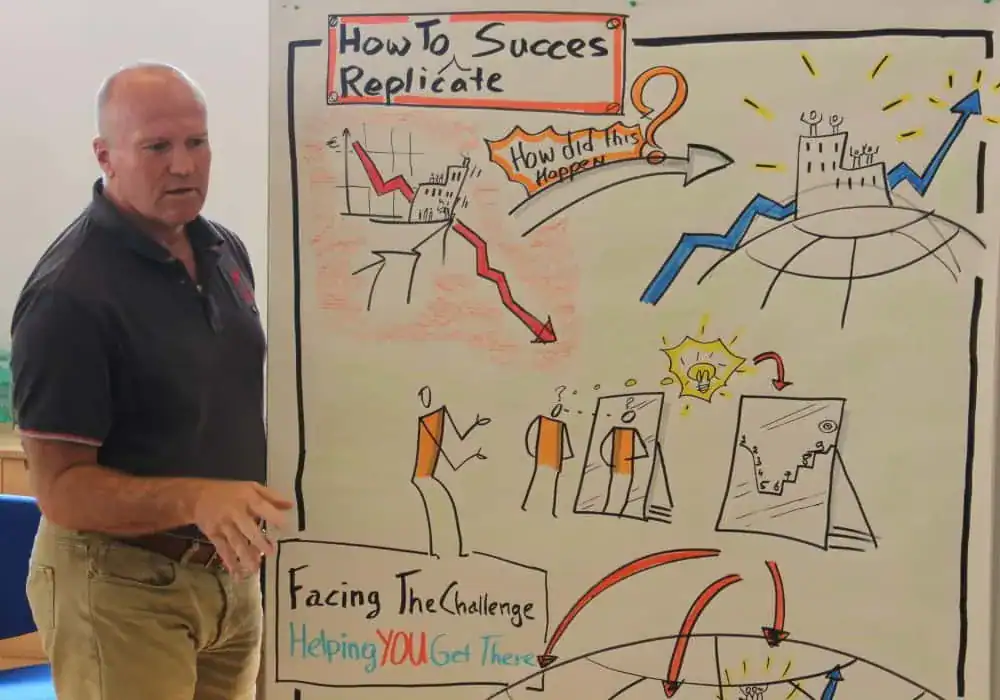
Everyone wanted to know how he did it. Brilliant leaders from other countries visited. Studied him. Copied everything they could see. Nothing worked. Same strategies, same energy, same visible behaviours — completely different results.
So I did something nobody had done: I reverse-engineered exactly what made it work. Not the visible stuff — the speeches, the town halls. The invisible stuff. The leadership principles underneath. The moves he made that he couldn’t even articulate himself.
I found nine of them. Nine principles that formed a structured route from survival to sustained high performance. When I made them visible and transferable, suddenly it worked elsewhere.
“This is the first time we managed to successfully replicate my success. Since we used the blueprint, 2 other countries in our multinational are moving up the ranks fast.”— Joop Evers, Manager of the Year
The problem isn’t people. It’s the playbook. Make the playbook visible, make it transferable, and the same people produce completely different results.
Epiphany two: the consulting model is broken
Two senior consultants asked me to join a culture transformation at one of the largest asset managers in the Netherlands. Before agreeing, I asked one question: “What do you actually want to achieve with our collaboration?”
Their answer: “Take control together, bring in more consultants, and earn on volume.”
I asked how flooding an organisation with external people would serve the client. Silence. I asked what would happen managing dozens of consultants — availability, quality, continuity. More silence.
Then they asked: “OK Robert… how would you do it?”
“Take 20% of the tools from your consulting toolkit — the 20% that produces 80% of the results — and instead of giving them to consultants, give them to the client’s own people. Coach them like in the outdoor world: direct feedforward, real challenges, their own processes end-to-end.”
They agreed. And from day one, the organisation’s own people went all in. Real problems, real bottlenecks, real ownership.
“You achieved in one year what twenty consultants couldn’t accomplish in the two years before you.”— GM, leading asset manager
The consulting model itself is the problem. The dependency, the external ownership, the tools-without-leadership — that’s not a bug. It’s a feature. Build the opposite — capability that stays inside — and the results are an order of magnitude better.
Those two epiphanies — the invisible playbook, and the inverted consulting model — became Facing The Challenge.
Same people. Different game.
€21M
Annual savings identified
A 1,400-person technical services organisation, post-merger. Their own people — not consultants — identified €21M in annual savings. Roughly 20% of their total yearly budget. Zero external consultants. One guide. Forty leaders did the rest.
“I could feel a shift in atmosphere within 2 weeks.” — W.K., Director of Operations
#1
From worst to best worldwide
Near-shutdown to #1 worldwide. 400 to 1,450 people in four years. And when the principles were extracted and made transferable, two other countries in the same multinational replicated the success.
Joop Evers, BPO Executive — Manager of the Year
3 weeks
Two problems gone
An €85M manufacturing company. Two handoff problems had persisted for over a year. Repositioned two leaders based on their wiring. No reorganisation. No new hires. Both problems disappeared within three weeks.
CEO, Manufacturing — €85M revenue
€200K
Five years of development — surpassed in one session
“I’ve spent €200K on team development in the past five years. This one session showed me more about why my MT wasn’t executing than all of it combined.”
Managing Director — Professional Services, €40M revenue
Four steps. Your team runs the business.
Everything I do follows from those two moments. Each step sells the next — not because I pitch it, but because the results from the current step make the next step obvious.
Make the friction visible
The Leadership Friction Scan measures structural friction across four dimensions — Bottleneck, Silos, Fixing, and Playbook. Twenty questions. Five minutes. A CEO sees exactly how much of their leadership energy is avoidable friction. Not guesswork. A number.
Map the wiring
Play2Win maps the leadership team’s collective wiring across every layer. Not individual personality profiles — the structural pattern that predicts where friction sits, where the multipliers are hiding, and which one positional shift produces the biggest output gain. In a single session.
Replace the playbook
Fit4Tomorrow installs the 9 leadership principles extracted from Joop’s turnaround. Two phases — The Slide and The Stairs. In 90 days, the leadership team operates differently. Same people. No one replaced.
Your people become the engine
Lean5Sigma takes the essential tools, puts them in the hands of your own people, and coaches them with direct feedforward and real ownership. They map processes end-to-end, build business cases, and execute. When we leave, the engine keeps running. Because the capability is theirs now. Permanently.
Six commitments
Same people
Nobody gets replaced. The friction is structural, not personal. Change the structure and the same people produce different results.
Results in euros
Not engagement scores. Not workshop ratings. Documented savings your CFO respects. The Lean5Sigma results component only triggers on formally documented outcomes.
The intelligence stays
Your own people build the capability. When we leave, the engine keeps running. That’s the opposite of how most consulting works — and it’s the whole point.
Skin in the game
The Insight Guarantee, the 90-Day Guarantee, the results component — these aren’t marketing. They’re structural proof that I stand behind the outcome, not just the process.
No dependency by design
The consulting industry creates dependency because it’s profitable. I build the opposite — you should need me less over time, not more.
Direct feedforward
Thirty years of working with teams in real time taught me one thing: people change through experience, not explanation. Every engagement is built on that principle.
See your number. Five minutes.
The Leadership Friction Scan measures structural friction across four dimensions. Twenty questions. Your score immediately. No sales pitch after — just your number.
20 questions · 5 minutes · Your friction score immediately